Wednesday, 28 March 2012

Module 4 chapter 6

This chapter is all about manipulating the shape of a slip.

I chose to work with some more of the digital designs, and as I'd decided to make use of a visit to my daughter's house to do some burning techniques I layered up three layers of sheer fabric and a nylon lace.


4/6/1

I used the opportunity to manipulate some of the fill patterns and lettering to create something different.

The above slips have all been cut from the background fabric with a soldering iron. After which they were carefully zapped with the heat gun to mould them into different shapes, and in the case of the 2 upper left samples, which were produced with metalic thread, give an impression of lace.


4/6/2


4/6/3


4/6/4

As I'd like to combine this type of slip with a designer style garment I've placed them on various fabrics that I think might work in this context.


4/6/5

When I cut out the above slips I'd stitched them very close together to get as many designs into the hoop as possible and when I looked at the piece holding the two together, I liked what I saw so I left it.

I then had a play with the negative shapes and overlaid a couple of designs over the hole.


4/6/6


4/6/7

Lastly I cut out a three of the unstitched tulip shapes and zapped them gently.


4/6/8

And a couple of random negative shapes.


4/6/9

I really enjoyed this chapter, which surprised me as previous attempts with heat tools have left me cold, but I think maybe the loan of a gas soldering iron made all the difference, it seemed much easier to use than an electric one as it has no lead of course, but once hot the heat seems much more constant and easier to use.

Friday, 23 March 2012

Module 4 chapter 5

In this chapter we were asked to explore the slip surface and the applied surface, that being the surface that the slip is attached to.

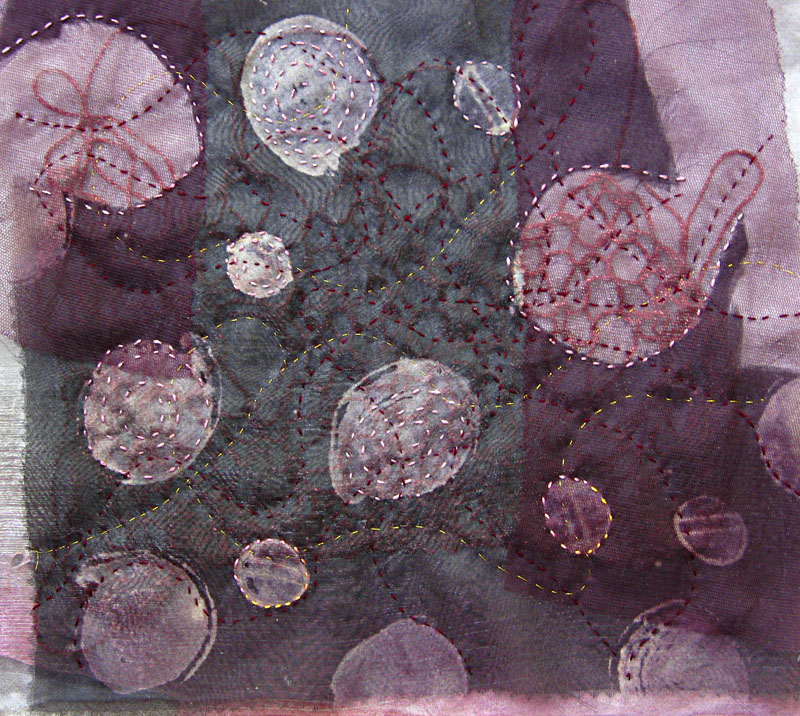
First I constructed two fabrics that could be used for cutting out slips. They're both constructed of layers of transparent fabric pieces.


4/5/1


4/5/2

This second piece has a piece of knitting sandwiched between the layers and is completely hand stitched. It would cut into slips as it's all stable and has been stitched onto a water-soluble under layer, as has the top fabric. However I rather liked it so for the time being it has become an applied surface.


4/5/3


4/5/4

The slips were stitched in the first fabric, starting with a couple of the digital designs and then working through a variety of different outline stitches.


4/5/5

They were then cut and offered up to the applied surface.


4/5/5


4/5/6


4/5/7


4/5/8


4/5/9


4/5/10


4/5/11

I was very pleased with the way the machine handled the digital slips on the hand constructed fabric, I shall try more of these later.

Wednesday, 21 March 2012

Module 4 chapter 4

Reinventing the Elizabethan slip.

I started this chapter by exploring the shape that I ended up with in chapter 3, plus looking at one or two others.


4/4/1

Having settled on the shape I then produced 4 digitally embroidered slips and started looking at complimentary colours and textural ideas to mount them on.


4/4/2

The fills for the slips are as follows:

1. A simple blackwork fill

2. A lace fill under a wave fill

3. A candlewick fill

4. 2 blackwork fills, one on top of the other


4/4/3

After looking at the above, I then worked my four contemporary slip samples.


4/4/4

This slip is mounted on a piece of felted knitting using French knots to hold it in place.


4/4/5

The above sample is mounted on silk Dupion with a copy of the slip design stitched to the fabric and the slip itself has been stitched in place with machine straight stitch.


4/4/6

I thought the geometric shapes of this slip would work well on a silver net and secured it with gold beads.


4/4/7

This sample was really difficult to photograph as I wanted to show its transparency. It's mounted on metallic organza and secured with running stitch in silk thread.

This was quite a fun chapter to do , especially as I had the chance to work with the digital embroidery again. I think the shape was a little awkward to work with and the results of the samples were quite tight.

Friday, 16 March 2012

Module 4 chapter 3

This chapter is out of sequence as I haven't completed chapters 2a/b as I plan to run them alongside the other chapters as they're hand stitch and therefore very portable.


4/3/1

As you can see by the above image this chapter is mainly to do with exploring your chosen flower digitally and by hand sketching to look at possible stitching potential.


4/3/2

All manipulation has been carried out using Photoshop CS4 and the above composite shows some of the filters I have used.


4/3/3

This was the hand worked sketch which was the starting point for the composite.


4/3/4


4/3/4

A couple more digital play, the bottom one has had considerably more manipulation than the others.

Then Sian suggested that we could either sketch the flower or the digital versions, something that's never occurred to me before, so I was pretty pleased with myself when I came up with these.


4/3/5


4/3/6


4/3/7

And last of all a shape to take on to further exercises.


4/3/8

This was a very pleasant exercise and a welcome return to digital manipulation, but with the added idea of sketching what you've created by hand you then bring it back to a more textile friendly design.

And also, in my case a welcome distraction to the production of the compulsory stitch element of the course. Just a personal thing as I find stitch diagrams invariably impossible to follow and even struggle with YouTube videos.

Tuesday, 13 March 2012

Module 4 chapter 1b


In this chapter I chose to look at a single flower and see how it differs in it’s embroidered translation, depending on the country of origin.

I chose a tulip, which originates from Hungary, and when the country came under Ottoman rule in the mid 1500’s, the flower then arrived in Turkey. The Turks adopted it as their symbol of life and fertility. The name was derived from the habit of the Ottoman sultan’s of wearing a tulip in their turban, the Persian word for which is Tulipan.

In 1562 the first tulip arrived in Europe via Antwerp.

It would appear that from the very beginning tulips have been connected with fertility.


4/1/1


4/1/2


4/1/3

These 2 pieces are part of a bed curtain from Slovakia featuring pulled threadwork and satin stitch.

‘To protect the mother and newborn child from evil spirits, both were confined for forty days behind the an embroidered curtain. Pulledwork enabled the mother to see into the room and and the designs were usually symbolic, here the tulip of fertility.’ Embroidered Textiles Sheila Paine


4/1/4

Different countries had used different symbolism for childbirth and Christening of a baby.
In Griffons, Switzerland the protection was offered by the symbolic tree of life with the fertility motifs of carnation and tulip.’Embroidered Textiles Sheila Paine

I also found a beautiful tulip embroidery on an Elizabethan glove which is in the the V&A collection and can be seen here


4/1/5

In the course of my research I found Hedebo Embroidery, which is beautiful whitework made in Denmark, and amongst the collection of designs was this delightful tulip which is known as the Hedebo flower.

Bibliography

http://www.tulip-info.com/

http://genvieve.pbworks.com/w/page/9773760/Satin%20Stitch%20Tulip

http://køge.info/hedeboeng/om_hedebosyning/hedebo-og-motiverne/flora

Shiela Paine Embroidered Textiles Traditional Patterns from Five Continents with a worldwide guide to identification Thames and Hudson 1995 London

Resources

Mike Young Photo library

Saturday, 10 March 2012

Module 4 chapter 1a

The historical part of this module is all about the use of flowers in Elizabethan embroidery, so to start with I have taken a broad overview.

Overview

The fashion for highly decorated embroidered clothing and household textiles was at an all time high in the Elizabethan era.

It was used as an indication of class and only those in the highest echelons of power were allowed to express their wealth and power through their elaborate dress. Only the Queen and her relations could wear clothes that used gold or gold fabric, as dictated by the Sumptuary Law.

Sumptuous embroidery was now being used by the upper classes as a status symbol, which was a very different use to previous times when it had been exclusively used for the church vestments.

At the same time there was a rise in printing after the invention of the printing press in 1476 which allowed the upsurge of interest in all things artistic and educational, to be readily accessible to the wealthy middle classes.

Flowers were a very popular subject for Elizabethan embroidery. There were 14 known herbal or gardening books published in the 16th century.

The following flowers were known to be used in their embroidery designs.

Roses – including the rosa alba (white rose) and damask rose
Carnations (also known as gillyflowers)

Iris

Red peony
Pansy (also known as love-in-idleness and cupid’s flower)
Daffodils (also known as narcissus)

Violets

Wild hyacinth (also known as bluebell)
Honeysuckle (also known as woodbine)
Cornflowers (also known as blewbotles)
Daisy

Other design sources included emblem books and bestiaries, as well as charted design books.

The flower designs were often worked as slips which were then applied to a background fabric, sometimes linen and often the more sumptuous velvet.

Flower designs were also interpreted in the popular blackwork technique. This is usually thought to have been popularized by
Catherine of Aragon, having introduced it to England from her Spanish origins.

There are also lots of surviving examples of work containing, tent stitch, double running stitch, couching and detached buttonhole stitch.


4/1/1

In the above composite, I've concentrated on Blackwork plus black and white design sources.

1. This is a pillowcase design from the V&A collection, the original is in storage.
Museum number:T.82-1924


4/1/1a

2. A piece of a painted cloth, possibly used for a wall decoration. This is displayed at The Weald and Downland Open Air Museum at Singleton in Sussex

3. Smock in the V&A collection


4/1/2

Place of origin:
England: Great Britain (embroidered)

Date:
1575-1585 (made)

Artist/Maker:
Unknown (production)

Materials and Techniques:
Embroidered linen with silk

Museum number:
T.113 to 118-1997

Gallery location:
British Galleries, room 58d, case 1


4. A Coif in the Platt costume gallery, Manchester Art Gallery


4/1/3

5 A Coif in the V&A collection

Place of origin, Great Britain, United Kingdom (made)

Date:
1570-1599 (made)

Artist/Maker:
Unknown (production)

Materials and Techniques:
Linen, silk thread, linen thread; hand-sewn and hand-embroidered with hand-made bobbin lace

Credit Line:
Given by Mrs M E Grubbe

Museum number:
T.12-1948

Gallery location:
Textile study centre panel G15

6. A facsimile page from A Schole house for the needle by Richard Schorleyker, published in 1624, but containing typical motifs. (from the V&A Museum)

With the exception of the Coif in the Platt Museum I have viewed all the other pieces in person.


4/1/4

This next composite concentrates on the colours and types of flowers that were used in Elizabethan embroidery.

1. This is part of the Uvedale Monument at St. Nicholas church at Wickham in Hampshire. The details on the jacket are beautiful and look as if they feature pansies and cornflowers.

2. This is an octagonal slip that was stitched by Elizabeth Shrewsbury (Bess) , synonymous with Harwick Hall in Derbyshire. It matches other slips that were made by Bess and Mary Queen off Scots which were mounted for a set of hangings that are now displayed at Oxburgh Hall in Norfolk.

3. The Margaret Layton Jacket

Place of origin:
England, Great Britain (made)

Date:
1610-1615 (made) 
1620 (altered)

Artist/Maker:
Unknown (production)

Materials and Techniques:
Linen, embroidered with coloured silks, silver and silver-gilt thread

Credit Line:
Acquired with the assistance of the National Heritage Memorial Fund, The Art Fund and contributors to the Margaret Laton Fund

Museum number:
T.228-1994

Gallery location:In Storage

4. A corner of a large linen cover, worked with red, blue, green and black silk, mainly in stem, chain, speckling, knotted and double running stitch.
V&A collection, scanned images from Elizabethan Treasures, The Hardwick Hall Textiles, Santa M Levey

One of the most interesting areas of study for me was discovering a recreation of a Layton style Jacket that was made by members of the Plimoth plantation Museum

It was an amazing achievement to recreate a jacket from the 1620'2, the style and cut of which was chosen from the Layton Jacket, in the V&A collection. The pattern was taken from another jacket, also at the V&A museum, this one was considered to be more beautiful.


4/1/5

This sketch is a vey small section of one of the motifs on the Layton Jacket, there are 27 on the Plimoth jacket.

Many of the materials had to be specially made, including gilt sylk twist thread and a special hand made needle from Japan.
Nearly 1000 spangles were made by the museum blacksmith, and lacemakers had to discover how to make the silver and gold bobbin lace. The lining for the jacket was hand dyed and hand woven.

During the construction process all the seams were covered in plaited braid, an amazing achievement in itself.

The project took a staggering 3,700 hours to complete.

There is a beautiful reveal video here

And a lovely PDF brochure of the whole manufacturing story here.

I've just found Vivienne Westwood's Elizabethan inspired collection for Autumn/Winter 2012, I love it, particularly the pieces at the end of the collection


4/1/6

Bibliography

http://www.buzzle.com/articles/clothing-in-elizabethan-era.html

http://dlibrary.acu.edu.au/staffhome/siryan/academy/theory_history/elizabethan_period.htm

http://www.grimfells.net/elizabethan_embroidery.pdf

http://medieval.webcon.net.au/loc_england_elizabethan.html

http://www.vam.ac.uk/page/t/textiles/

http://www.winterthur.org/pdfs/Plimoth-Jacket.pdf

Elizabethan Treasures, The Hardwick Hall Textiles, Santa M Levey